
One Crane. What Boston's Ground-up Slowdown Means for Boston's Interior Construction Companies.
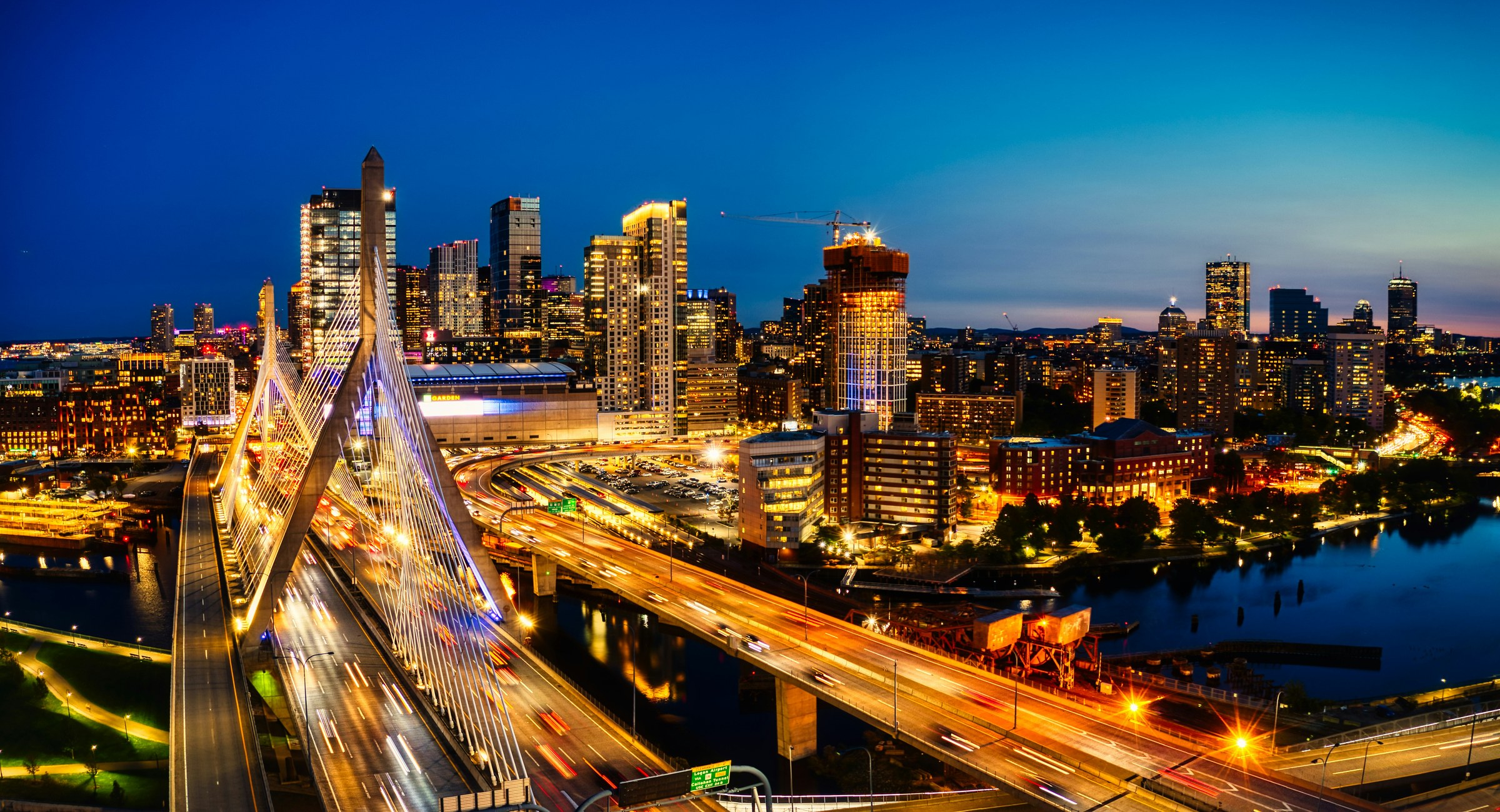
In Q1 2026, there was a single tower crane active on the Boston skyline.
One.
According to construction consulting firm Rider Levett Bucknall, whose Crane Index tracks active tower cranes across 18 major North American cities, Boston recorded one of the sharpest declines of any market surveyed — a drop of more than 20% year-on-year, putting it alongside Seattle, Portland, and New York as the hardest-hit cities in the report.
For context: Toronto currently has 80 active cranes.
What's driving it
The causes are well documented at this point. Interest rates for construction loans have more than tripled since pre-COVID levels. Overall materials costs have jumped 43% since the start of 2020. Lumber, steel, concrete — none of it has come back down to where it was. And Boston layered its own structural challenges on top of that: a 20% affordable housing requirement on new developments, energy efficiency code standards, and the cost premium that comes with union labor on large-scale projects.
The result is that Boston's Wu administration is now projecting just $40 million in new development tax revenue for the coming fiscal year — the smallest figure since 2016. Developers who have the permits aren't pulling the trigger, because the numbers don't close. As one developer put it: "Either you get to the 6.5% return on cost, or you don't have a project."
Meanwhile, cranes that would previously have been rising in the city have instead been moving to Revere, Lynn, Everett, and other communities outside city limits where the economics are more workable.
But the shift toward commercial and adaptive reuse is real
Here's what's interesting: while residential ground-up construction has stalled, something else is quietly accelerating.
Across North America, RLB's Q1 2026 data shows that commercial crane counts increased by 60% collectively. The overall pattern, as RLB's President of North America described it, is "a transition away from predominantly residential-driven expansion toward a more diversified development landscape." In Boston specifically, RLB noted renewed momentum in data centres, healthcare, and institutional work.
And then there's adaptive reuse — which in Boston's case has become a genuine construction growth story.
Boston's Office-to-Residential Conversion Program, launched in 2023 and extended through the end of 2026, has now received 22 applications covering 27 buildings and 1.2 million square feet of office space, targeting over 1,700 new homes. Several are already under construction. The largest downtown conversion approved to date — 280-300 Washington Street in Downtown Crossing — will turn vacant office space into 255 apartments. A 75% property tax abatement lasting 29 years is making the economics work for developers who couldn't otherwise justify the build cost.
In Worcester, the largest office-to-residential conversion in Massachusetts history is already underway: a 189,000 sq ft office building being converted by Synergy Investments into 198 apartments, backed by $51 million in financing. Construction began in May 2025.
What this means for construction in Boston
The pipeline is shifting, not disappearing.
Ground-up high-rise residential starts are on pause in the city core. But commercial fit-out, interior build-out, and adaptive reuse work is active and growing. Converting office buildings to residential requires significant construction effort — new MEP systems, structural modifications, new facades in some cases, full interior gut renovations — and it is work that draws heavily on the same skill sets as ground-up development.
For the Boston construction market, this means the work is moving. Not gone — moving. The teams best positioned over the next two to three years will be those with experience across project types, who can operate effectively on a complex adaptive reuse job as readily as on a new-build.
The crane count will recover. It always does. But while the skyline is quiet, there is a significant amount of construction happening inside buildings that already exist — and that work is growing.
We place Project Management and Preconstruction professionals across Boston and the US East Coast.
Get in touch →